
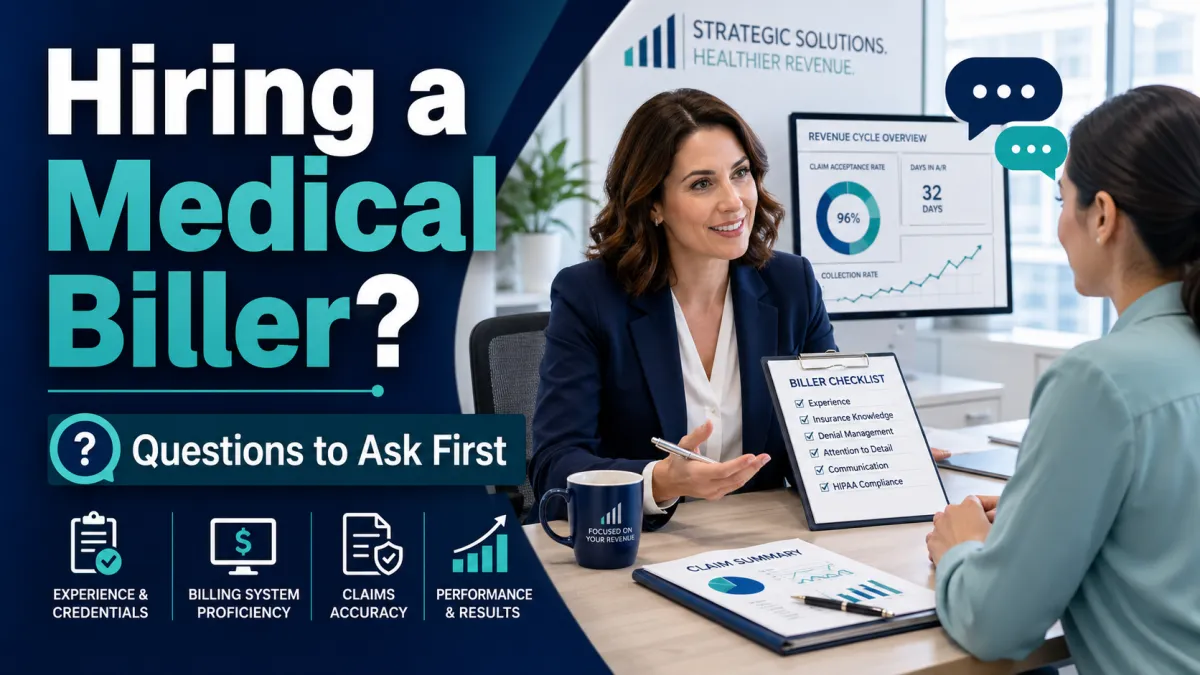
Interview Questions to Ask Before Hiring a Medical Biller
Interview Questions to Ask Before Hiring a Medical Biller
Hiring a new medical biller is one of the more important staffing decisions a medical practice can make.
A strong biller can help improve collections, reduce denials, keep AR moving, and give the practice better visibility into what is happening with claims.
A weak biller — or even a decent biller in the wrong role — can create delayed payments, unresolved denials, aging AR, missed revenue, and frustration for both staff and providers.
The challenge is that medical billing can be hard to evaluate during an interview.
A candidate may know the terminology. They may have experience. They may have worked in a billing office before. But that does not always mean they know how to solve problems, prioritize AR, communicate with providers, or identify revenue cycle issues before they grow.
The goal of the interview should not just be to ask whether the candidate has billing experience.
The goal is to understand how they think.
Start with the role your practice actually needs
Before interviewing candidates, be clear about what kind of billing help your practice needs.
Some billers are strongest at claim submission.
Some are better at AR follow-up.
Some are experienced with denials.
Some understand credentialing and payer setup.
Some are good communicators who can work with providers and front desk staff.
Some are task-oriented but may not be comfortable identifying patterns or recommending improvements.
That matters because “medical biller” can mean different things in different practices.
Your practice may need someone who can:
submit claims cleanly
work aging AR
resolve denials
post payments
review underpayments
communicate with payers
explain billing issues to providers
identify workflow problems
manage patient balances
help improve billing processes
If the job requires problem-solving, do not only ask task-based questions.
Ask questions that reveal whether the candidate can recognize patterns, prioritize work, and help the practice collect what it should.
Interview questions about billing experience
Start with basic experience, but do not stop there.
Ask:
What types of medical practices have you billed for?
What specialties have you worked with?
What billing systems or EMRs have you used?
What parts of the billing process have you personally handled?
Have you worked with in-house billing, outsourced billing, or both?
What payers have you worked with most often?
Have you handled Medicare, Medicaid, commercial insurance, workers’ compensation, or self-pay balances?
What types of claims or services are you most comfortable billing?
What part of billing do you consider your strongest area?
What part of billing do you feel least experienced with?
Listen for specificity.
A strong candidate should be able to explain what they have actually done, not just say they “handled billing.”
Interview questions about denials
Denials are one of the clearest ways to evaluate a biller’s problem-solving ability.
Ask:
When a claim is denied, what steps do you take first?
How do you decide whether to correct, appeal, resubmit, or escalate a denial?
What denial types have you seen most often?
How do you track repeat denials?
How do you tell the difference between a one-time denial and a pattern?
Can you give an example of a denial trend you helped fix?
How do you communicate denial issues back to providers or front desk staff?
What would you do if the same denial kept happening every week?
How do you handle authorization-related denials?
How do you handle medical necessity or documentation-related denials?
A good answer should show that the candidate does more than touch denials one at a time.
You want someone who can recognize when a denial is a symptom of a larger workflow problem.
Interview questions about AR follow-up
Many practices have AR being worked every day, but not actually resolved.
Ask:
How do you prioritize accounts receivable?
Do you work AR by age, dollar amount, payer, denial type, or another method?
How do you decide which accounts need immediate attention?
What does it mean for an account to be truly resolved?
How do you handle high-dollar claims that are not moving?
How do you avoid spending too much time on low-recovery accounts?
What AR reports do you like to review regularly?
How do you handle claims over 90 days?
When do you escalate an unpaid claim?
What would you do if AR over 90 days kept growing even though you were working accounts every day?
The answer to that last question matters.
A weaker candidate may say they would “keep following up.”
A stronger candidate may talk about prioritization, payer patterns, denial categories, escalation, timely filing, documentation, and identifying why claims are not resolving.
Interview questions about underpayments
Underpayments are often missed because the claim looks paid.
Ask:
Have you reviewed claims for underpayments?
How do you know whether a payer paid correctly?
Have you worked with contracted fee schedules?
What would make you question whether a claim was underpaid?
How do you handle a claim that was paid but appears lower than expected?
Do you track underpayment patterns by payer or CPT code?
How do you communicate possible underpayments to management?
Have you ever identified a recurring payer reimbursement issue?
What is the difference between a paid claim and a correctly paid claim?
How do you prevent underpayments from being overlooked?
A strong medical biller should understand that payment posting is not just data entry.
Sometimes, the money received is not the money owed.
Interview questions about documentation and provider communication
Billing does not happen in isolation.
Providers affect revenue through documentation, coding support, timeliness, and clarity.
Ask:
How do you handle claims when provider documentation is incomplete?
How do you communicate documentation issues to providers?
What do you do if a provider repeatedly misses details needed for billing?
Can you give an example of a documentation issue that caused denials or lost revenue?
How do you explain billing requirements to providers without creating conflict?
What information do you need from providers to bill accurately?
How do you handle time-based services or services that require specific documentation?
What would you do if you knew a provider performed a service but the note did not support billing it?
How do you help providers understand the revenue impact of documentation?
How comfortable are you giving feedback to doctors or clinical staff?
This is important because Rev-Cycle often finds that providers are doing work that is not fully supported in the documentation. When that happens, the practice may miss revenue or face preventable denials.
A biller who can communicate those issues clearly can be very valuable.
Interview questions about front desk and workflow issues
Many billing problems start before the claim reaches the billing team.
Ask:
What front desk mistakes most commonly create billing problems?
How do eligibility issues affect claims?
How do authorization problems usually show up in billing?
How would you communicate recurring intake errors to the front desk team?
What information should be verified before a visit?
How do you handle incorrect insurance information?
How do you identify whether a denial started at the front desk, with the provider, or in billing?
What workflows do you think every practice should have in place?
How do you document recurring workflow problems?
Have you ever helped improve a billing-related workflow?
A strong candidate should understand that revenue cycle performance depends on the whole practice, not just the billing desk.
Interview questions about reporting
Practice owners need visibility.
Ask:
What billing reports should a practice owner review each month?
How would you explain AR to a non-billing person?
What denial reports do you find most useful?
How do you report unresolved claims?
How do you show whether collections are improving?
How do you track productivity without confusing activity with results?
What numbers would concern you in a billing report?
How would you explain a sudden drop in collections?
How would you present the top billing problems to leadership?
What information do you think providers should see regularly?
A good biller does not need to be a financial analyst.
But they should be able to explain what is happening clearly enough that the practice owner can make better decisions.
Interview questions about judgment and problem-solving
These questions help reveal how the candidate thinks.
Ask:
Tell me about a time you found money a practice was missing. What did you find?
Tell me about a time you improved a billing process.
What do you do when a payer gives conflicting answers?
How do you handle a claim that has been worked several times but still is not paid?
How do you decide when to stop working an account?
What would you do if collections were down but patient volume was steady?
What would you do if denials increased suddenly?
What would you do if the provider says the billing team is wrong, but the claim keeps denying?
What would you do if a billing process was technically being followed but still not producing results?
What do you think causes practices to lose revenue even when everyone is working hard?
These questions are valuable because they test whether the candidate can think beyond the task list.
Interview questions about compliance and professionalism
Medical billing involves sensitive information and real financial consequences.
Ask:
How do you protect patient information in your daily work?
How do you handle a possible billing error?
What do you do if you are asked to bill something that is not supported by documentation?
How do you handle pressure to write off balances quickly?
How do you stay current on payer rules or billing changes?
How do you document your claim follow-up work?
How do you handle patient billing complaints?
What would you do if you discovered a pattern of incorrect billing?
How do you balance revenue recovery with compliant billing?
What does ethical billing mean to you?
You want someone who understands that the goal is not just to get claims paid.
The goal is to get the practice paid correctly and appropriately.
Red flags during a medical biller interview
Be cautious if a candidate:
speaks only in vague generalities
cannot explain how they prioritize AR
says all denials are handled the same way
has no process for identifying patterns
does not understand underpayments
avoids talking about documentation
does not communicate well
blames providers, front desk, or payers without explaining solutions
cannot explain reports clearly
focuses only on claim submission and not resolution
seems uncomfortable escalating issues
does not understand compliance boundaries
Experience matters, but judgment matters more.
Strong signs during the interview
Good signs include:
they explain processes clearly
they understand denial patterns
they know how to prioritize AR
they recognize documentation issues
they can communicate with providers and staff
they understand that a paid claim may still be underpaid
they know when to escalate
they can explain billing issues in plain language
they focus on resolution, not just activity
they understand the whole revenue cycle
The best billers do not just process claims.
They help protect the revenue of the practice.
Consider a working exercise
For an important billing role, consider giving the candidate a simple practical scenario.
For example:
Scenario:
Your AR over 90 days is increasing, but the current biller says accounts are being worked every day. What would you review first?
Or:
Scenario:
A payer keeps denying the same service for medical necessity. What steps would you take?
Or:
Scenario:
A claim was paid, but the reimbursement looks lower than expected. What would you do?
Their answers may tell you more than a resume.
Hiring the biller is only part of the solution
Even a good medical biller needs the right structure.
They need:
clear workflows
defined priorities
access to reports
provider cooperation
front desk accuracy
leadership support
escalation procedures
expectations for communication
If the practice does not have those pieces in place, even a strong biller may struggle.
That is why revenue cycle improvement is not only about hiring the right person.
It is also about building the right process around them.
Not sure what kind of billing help your practice needs?
Rev-Cycle helps medical practices identify missed revenue, denial patterns, AR issues, underpayments, documentation problems, and workflow breakdowns.
Sometimes the answer is hiring a stronger biller.
Sometimes it is training the current team.
Sometimes it is improving workflows.
Sometimes it is better oversight of an outside billing contractor.
Rev-Cycle’s role is to help you understand what is actually happening and what kind of support makes sense.
Start with a quick Revenue Clarity Call. We’ll take a few minutes to understand what you are seeing and help determine whether a focused review would be useful.
Book a Quick Revenue Clarity Call